
When Personhood Outlives the Person: The Constitutional Crisis of Brain-Dead Pregnancy
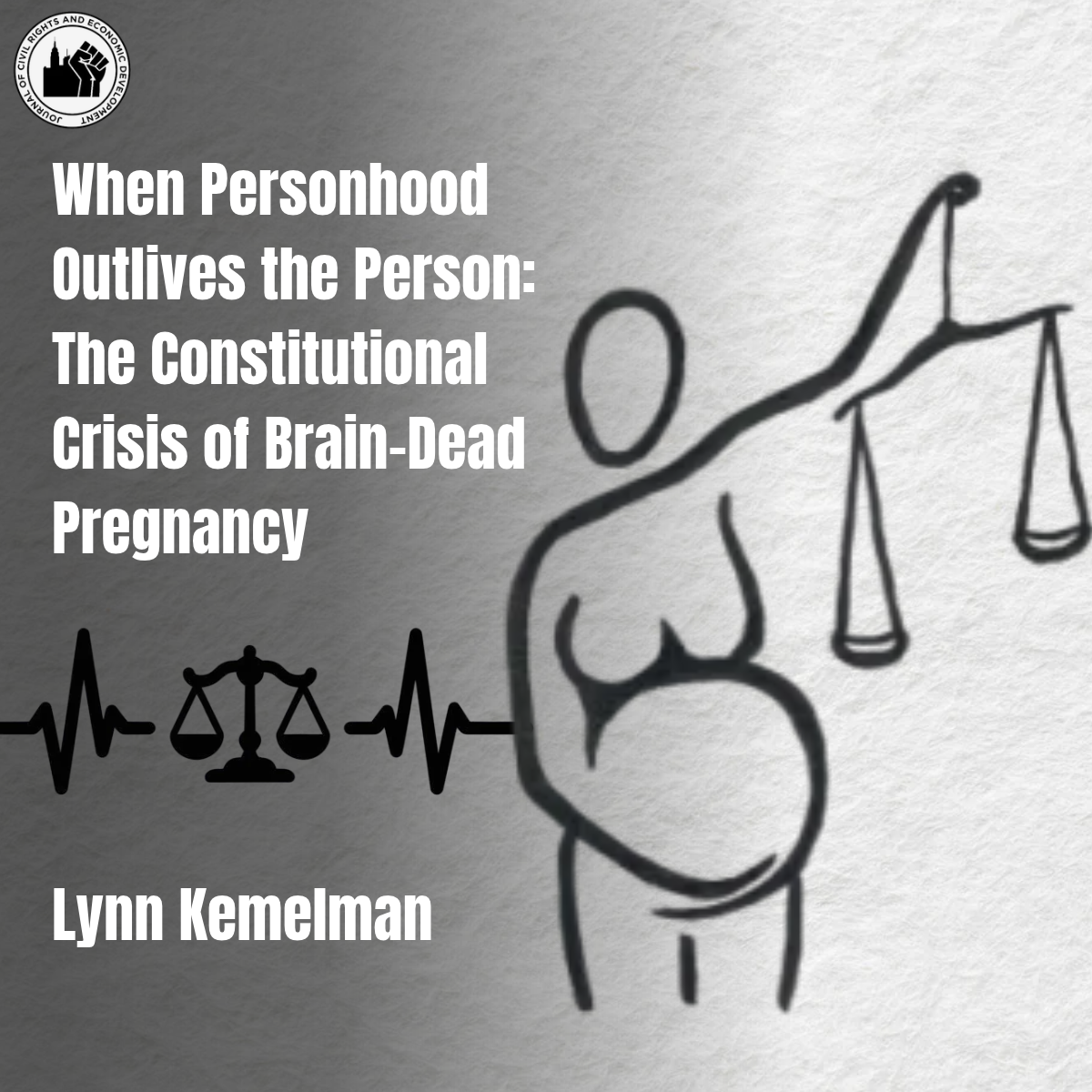
When Personhood Outlives the Person: The Constitutional Crisis of Brain-Dead Pregnancy by Lynn Kemelman
Image of a pregnant woman holding the scales of justice and a heartbeat monitor line intersecting with the scales of justice.
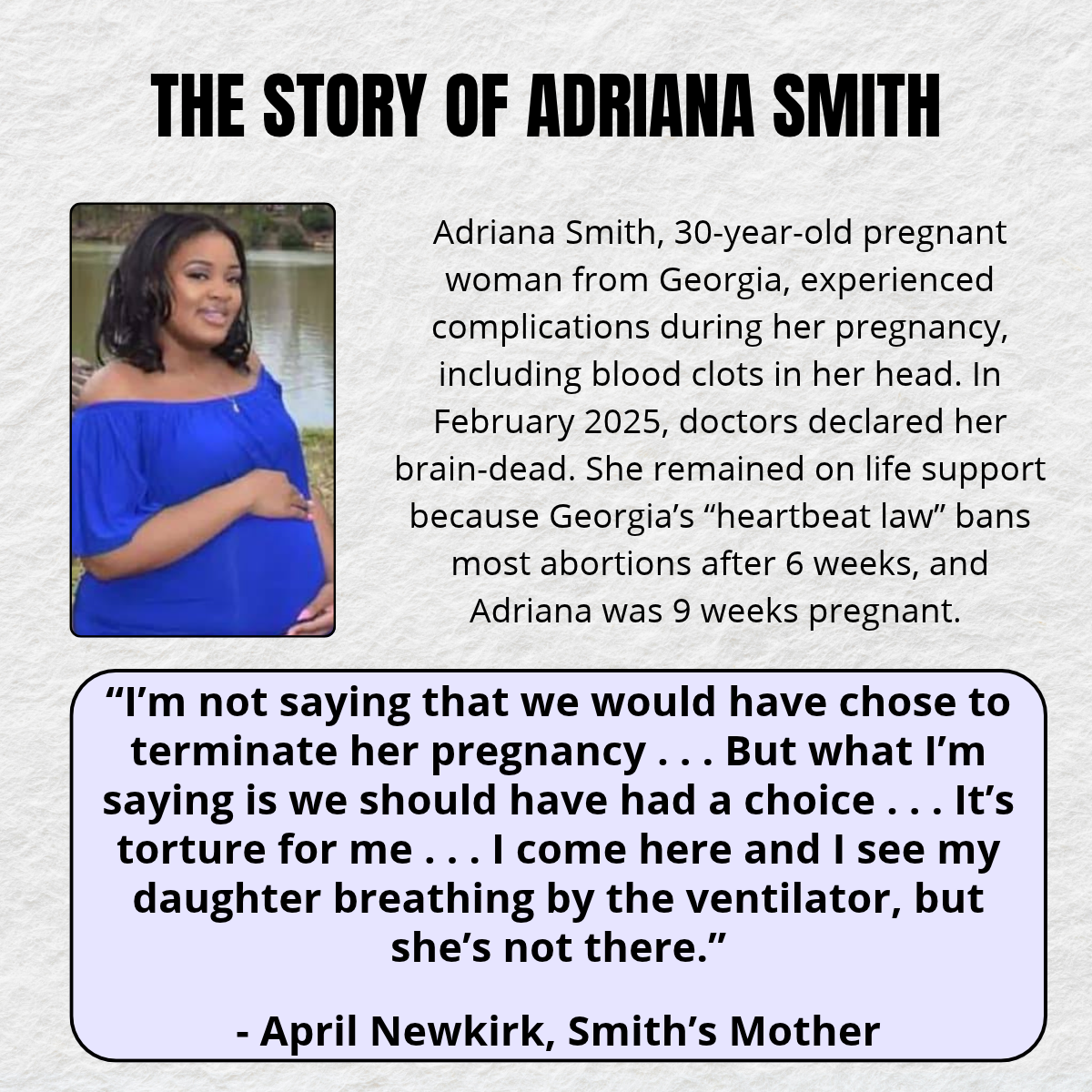
The Story of Adriana Smith
Adriana Smith, 30-year-old pregnant woman from Georgia, experienced complications during her pregnancy, including blood clots in her head. In February 2025, doctors declared her brain-dead. She remained on life support because Georgia’s “heartbeat law” bans most abortions after 6 weeks, and Adriana was 9 weeks pregnant.
“I’m not saying that we would have chose to terminate her pregnancy . . . But what I’m saying is we should have had a choice . . . It’s torture for me . . . I come here and I see my daughter breathing by the ventilator, but she’s not there.” - April Newkirk, Smith’s Mother
Image of Adriana Smith.
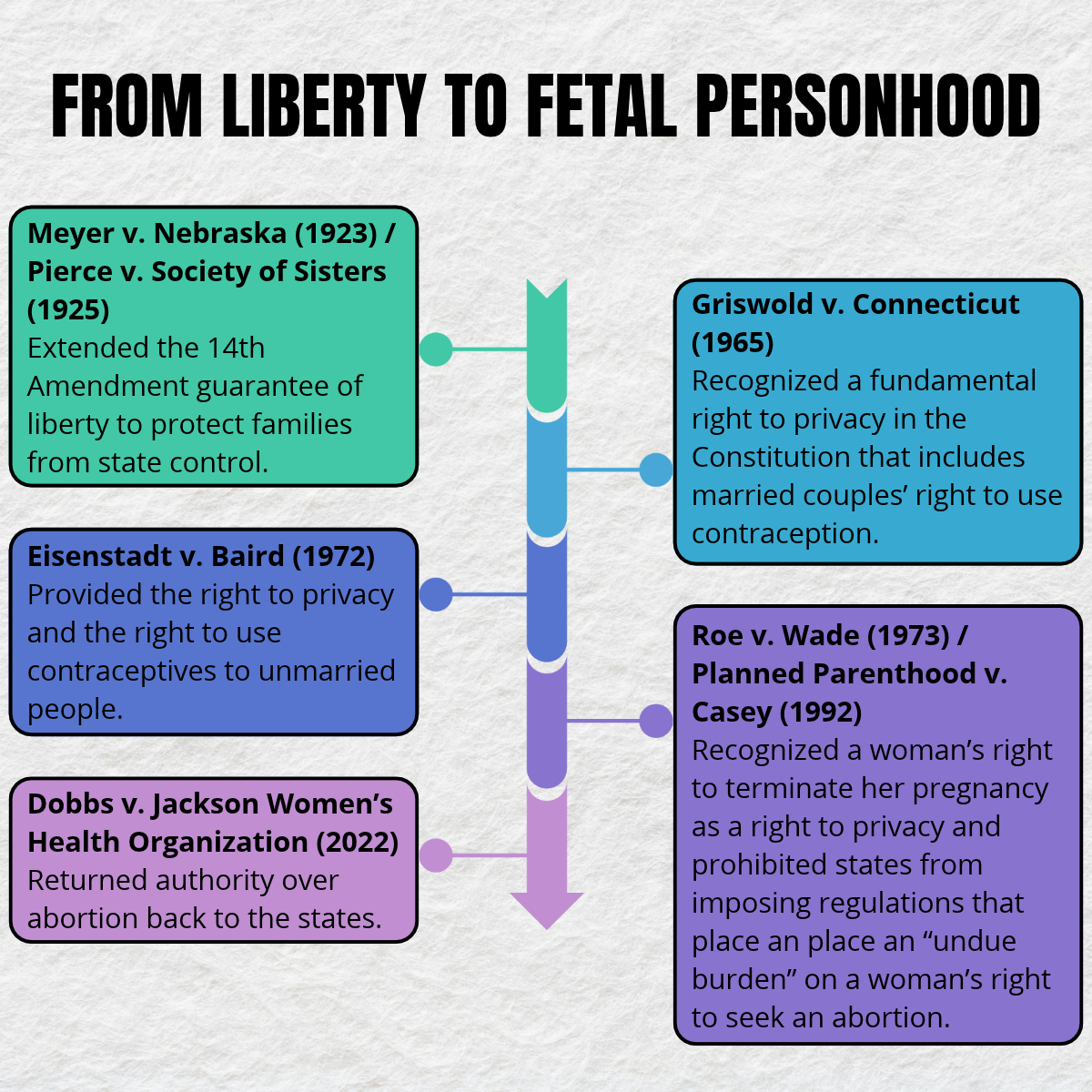
From Liberty to Fetal Personhood
Meyer v. Nebraska (1923) / Pierce v. Society of Sisters (1925) extended the 14th Amendment guarantee of liberty to protect families from state control.
Eisenstadt v. Baird (1972) provided the right to privacy and the right to use contraceptives to unmarried people.
Dobbs v. Jackson Women’s Health Organization (2022) returned authority over abortion back to the states.
Griswold v. Connecticut (1965) recognized a fundamental right to privacy in the Constitution that includes married couples’ right to use contraception.
Roe v. Wade (1973) / Planned Parenthood v. Casey (1992) recognized a woman’s right to terminate her pregnancy as a right to privacy and prohibited states from imposing regulations that place an place an “undue burden” on a woman’s right to seek an abortion.
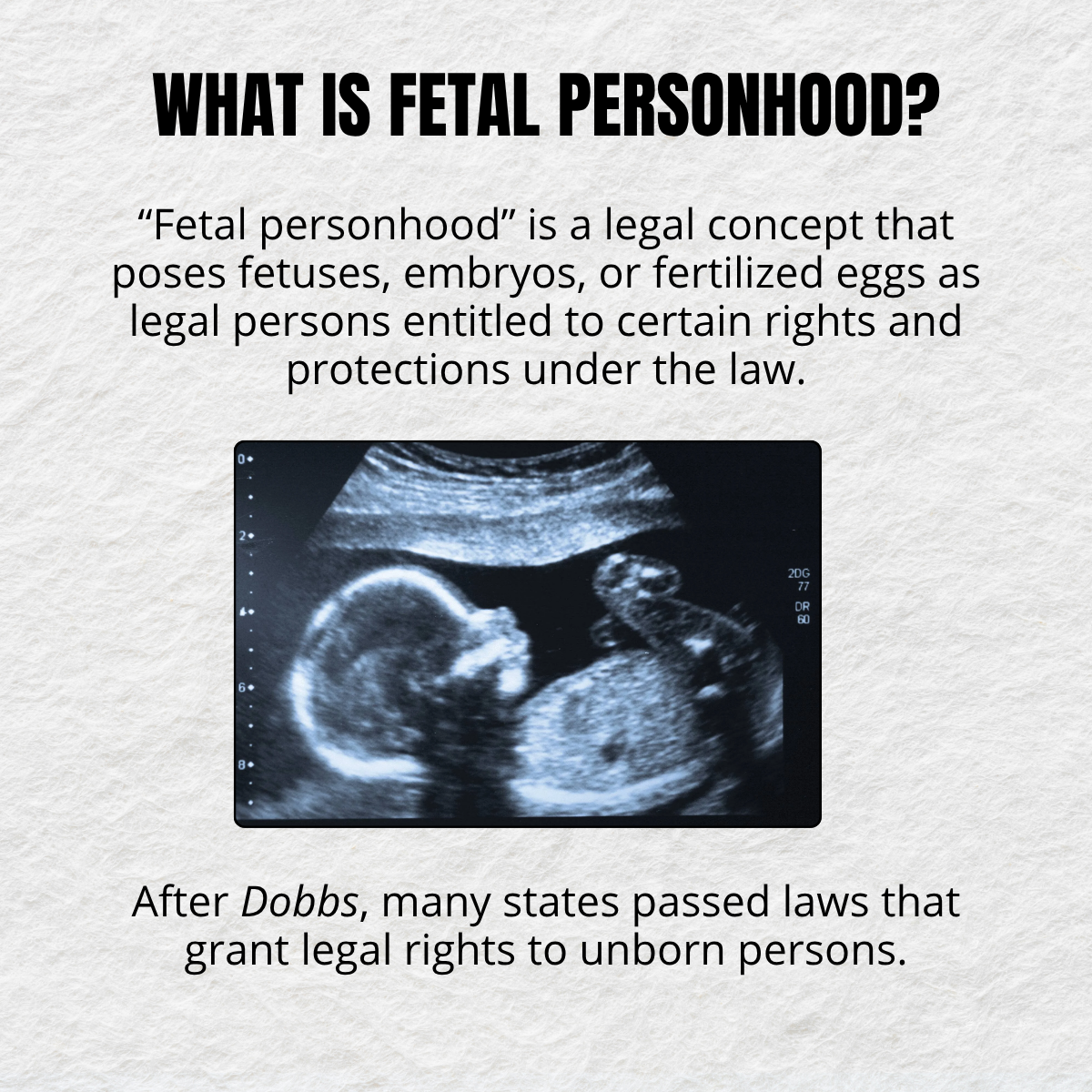
What is Fetal Personhood?
“Fetal personhood” is a legal concept that poses fetuses, embryos, or fertilized eggs as legal persons entitled to certain rights and protections under the law. After Dobbs, many states passed laws that grant legal rights to unborn persons.
Image of ultrasound.
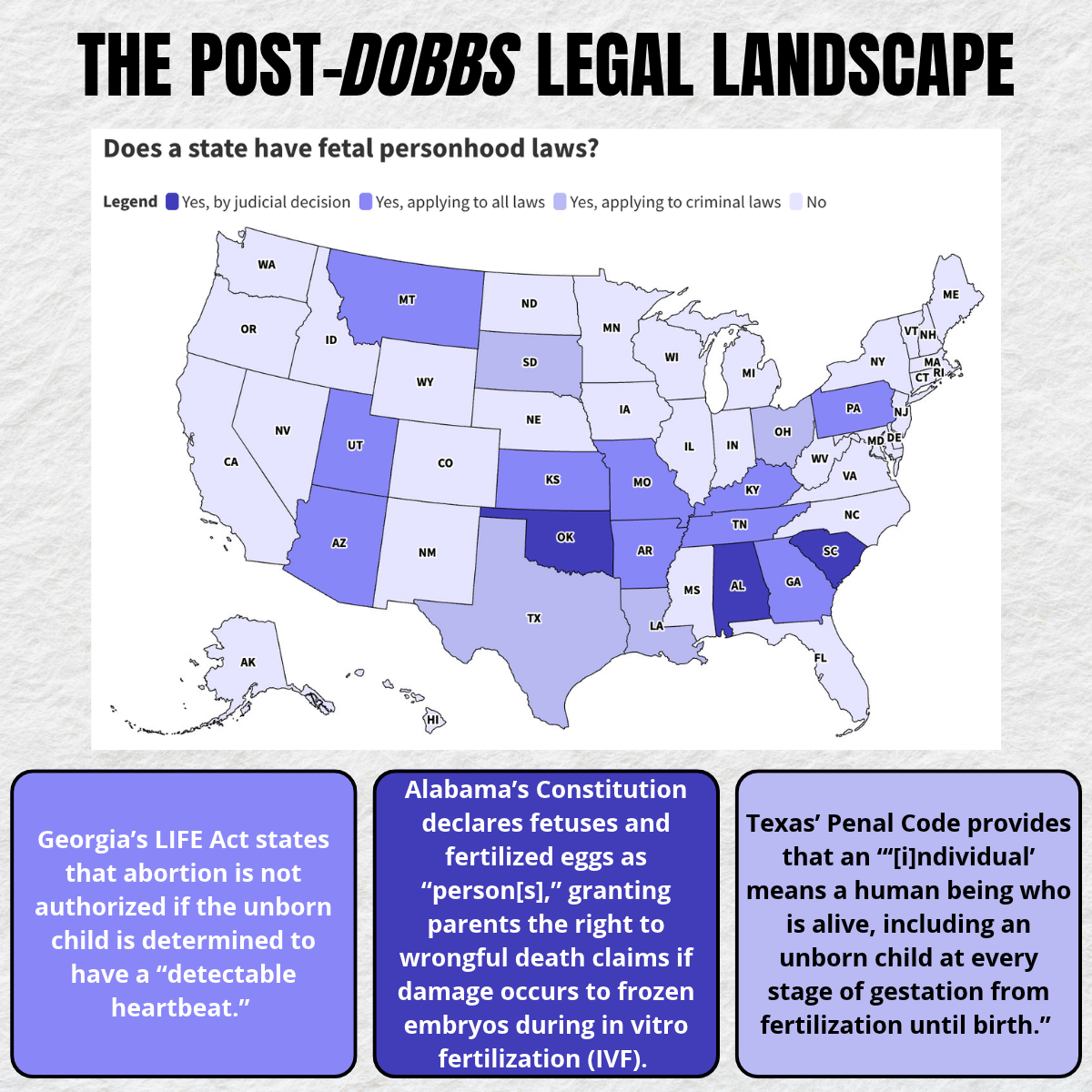
The Post-Dobbs Legal Landscape
Georgia’s LIFE Act states that abortion is not authorized if the unborn child is determined to have a “detectable heartbeat.”
Alabama’s Constitution declares fetuses and fertilized eggs as “person[s],” granting parents the right to wrongful death claims if damage occurs to frozen embryos during in vitro fertilization (IVF).
Texas’ Penal Code provides that an “‘[i]ndividual’ means a human being who is alive, including an unborn child at every stage of gestation from fertilization until birth.”
Map of the United States highlighting states with fetal personhood laws.
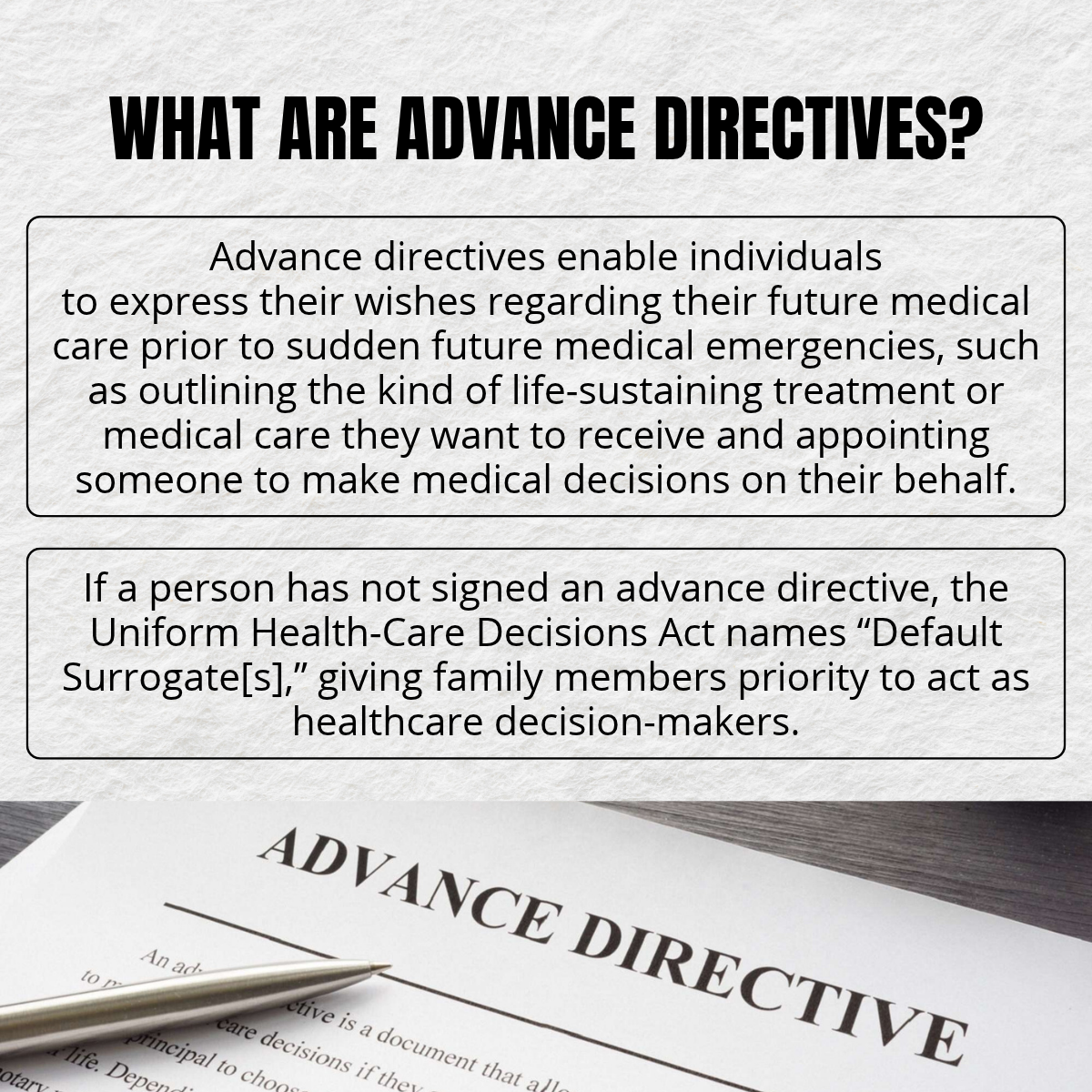
What Are Advance Directives?
Advance directives enable individuals to express their wishes regarding their future medical care prior to sudden future medical emergencies, such as outlining the kind of life-sustaining treatment or medical care they want to receive and appointing someone to make medical decisions on their behalf. If a person has not signed an advance directive, the Uniform Health-Care Decisions Act names “Default Surrogate[s],” giving family members priority to act as healthcare decision-makers.
Image of advance directive documents.
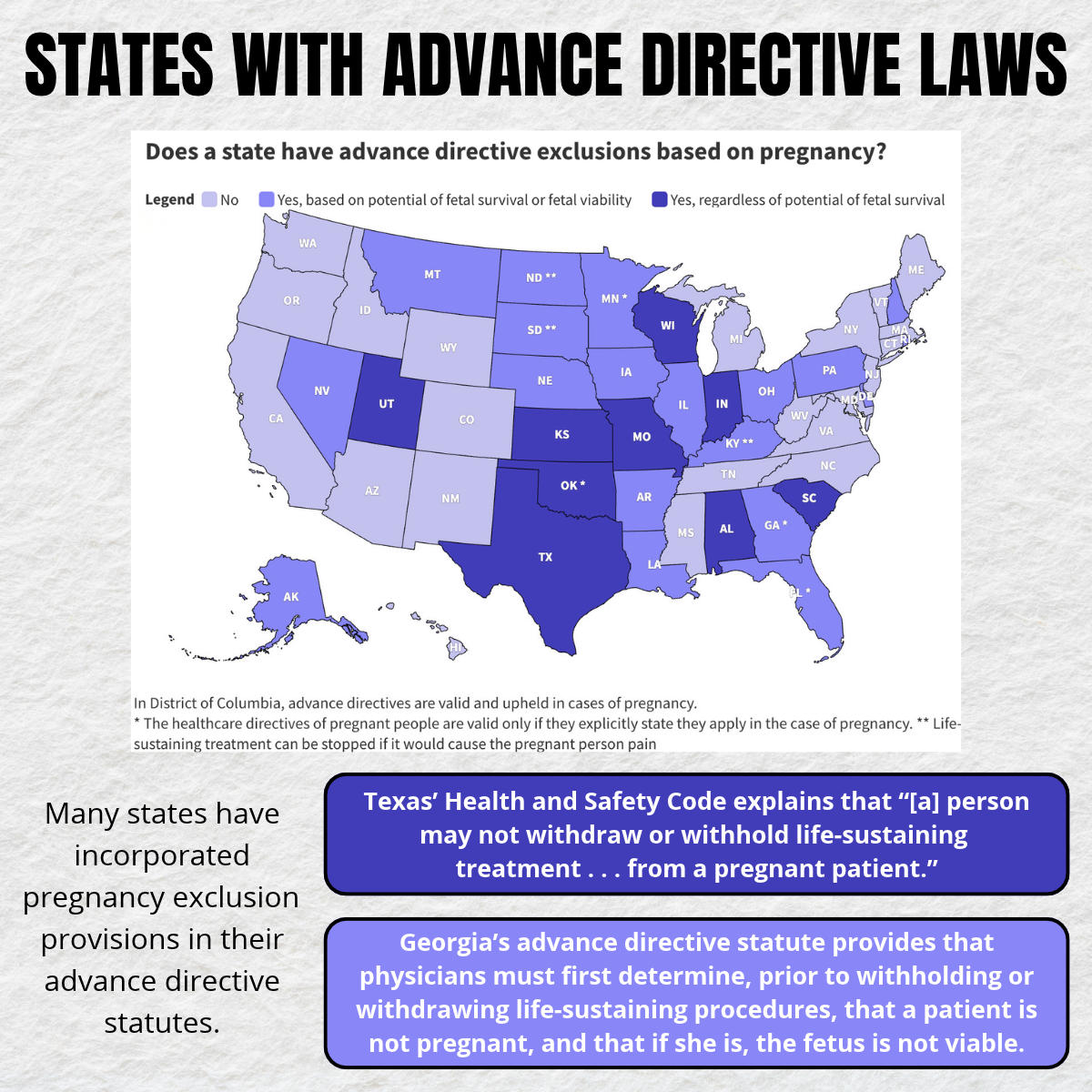
States With Advance Directive Laws
Many states have incorporated pregnancy exclusion provisions in their advance directive statutes. Texas’ Health and Safety Code explains that “[a] person may not withdraw or withhold life-sustaining treatment . . . from a pregnant patient.” Georgia’s advance directive statute provides that physicians must first determine, prior to withholding or withdrawing life-sustaining procedures, that a patient is not pregnant, and that if she is, the fetus is not viable.
Map of the United States highlighting states with advance directive laws.
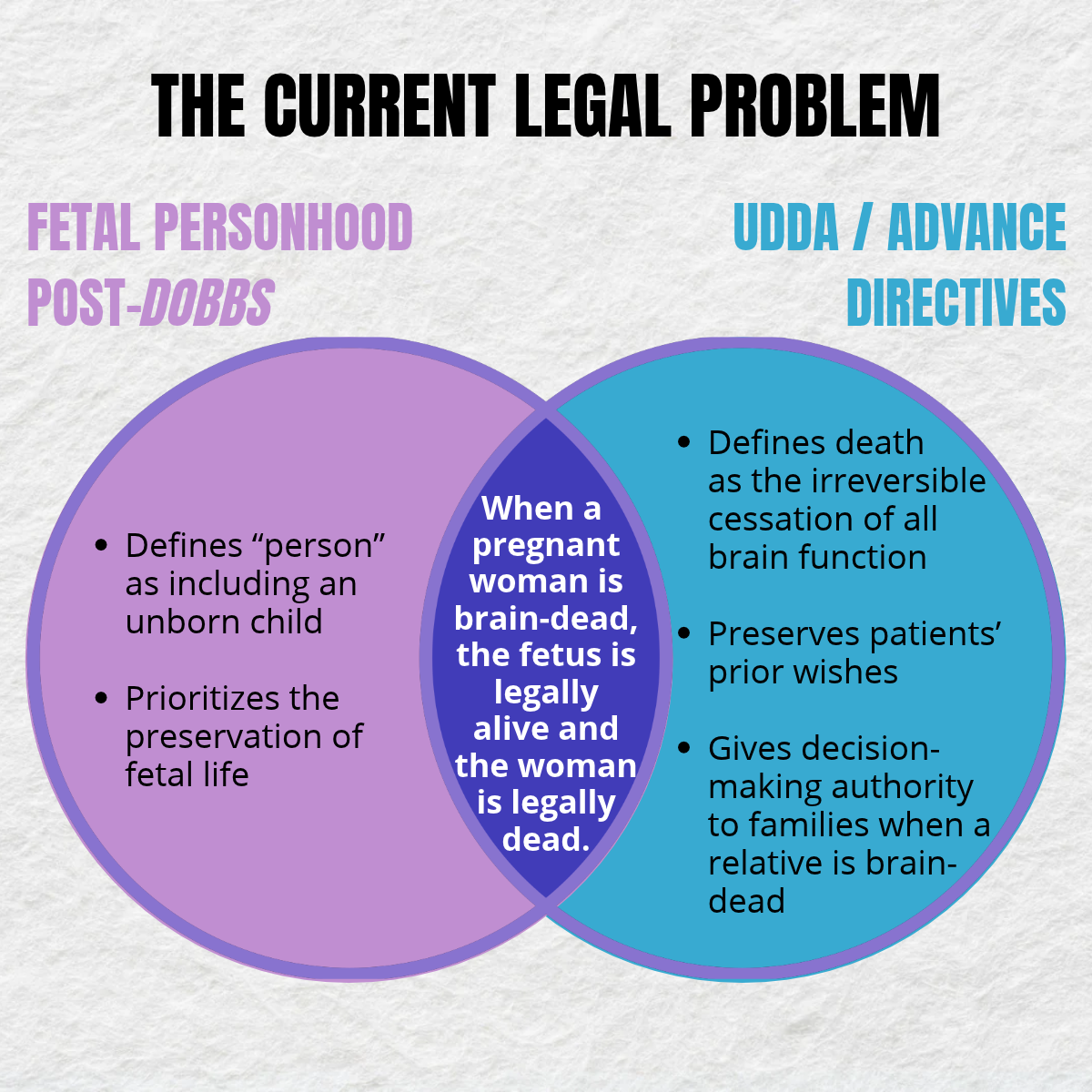
The Current Legal Problem
When a pregnant woman is brain-dead, the fetus is legally alive and the woman is legally dead.
Fetal personhood post-Dobbs defines “person” as including an unborn child and prioritizes the preservation of fetal life.
UDDA / advance directives defines death as the irreversible cessation of all brain function, preserves patients’ prior wishes, and gives decision-making authority to families when a relative is brain-dead.
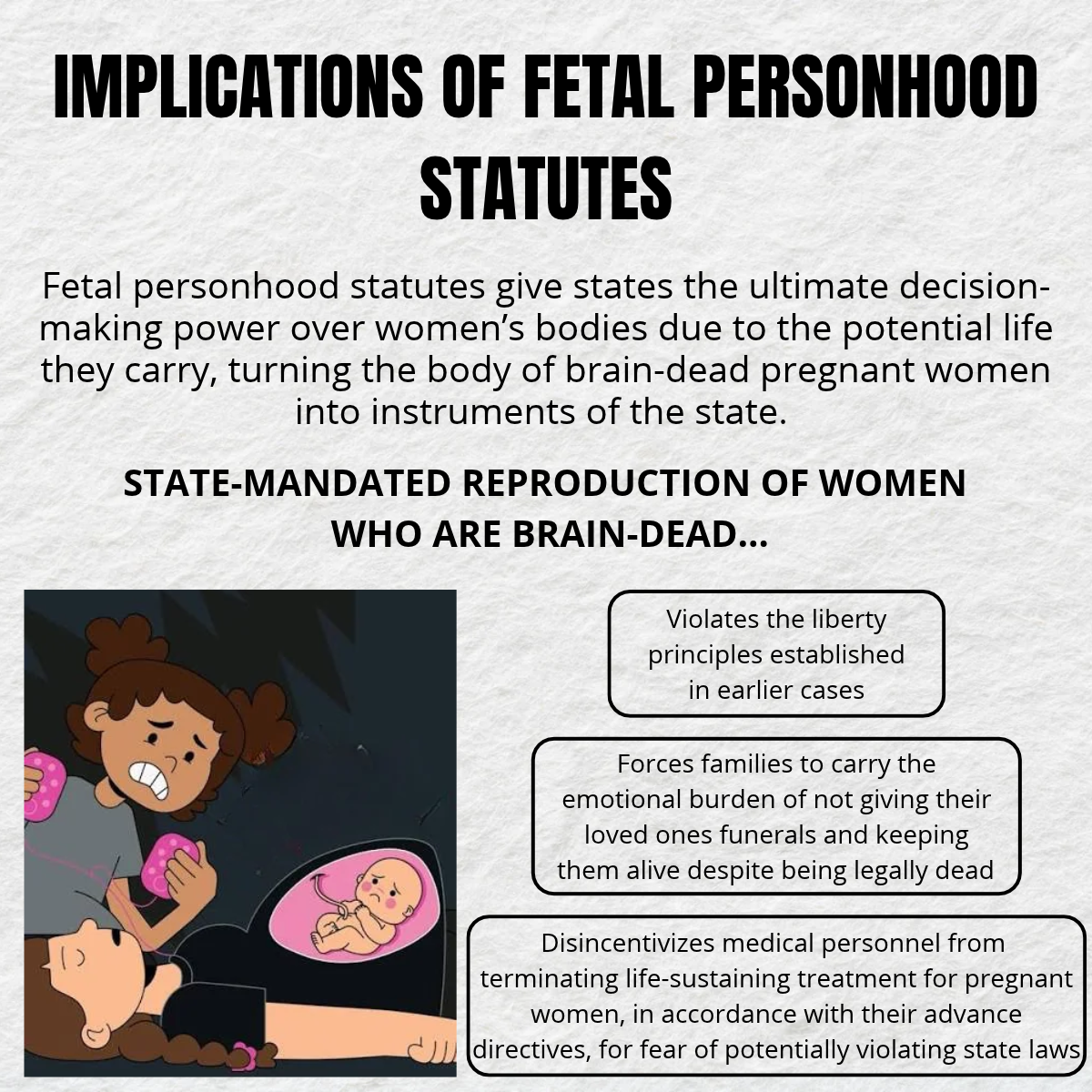
Implications of Fetal Personhood Statutes
Fetal personhood statutes give states the ultimate decision-making power over women’s bodies due to the potential life they carry, turning the body of brain-dead pregnant women into instruments of the state.
State-mandated reproduction of women who are brain-dead violates the liberty principles established in earlier cases; forces families to carry the emotional burden of not giving their loved ones funerals and keeping them alive despite being legally dead; and disincentivizes medical personnel from terminating life-sustaining treatment for pregnant women, in accordance with their advance directives, for fear of potentially violating state laws.
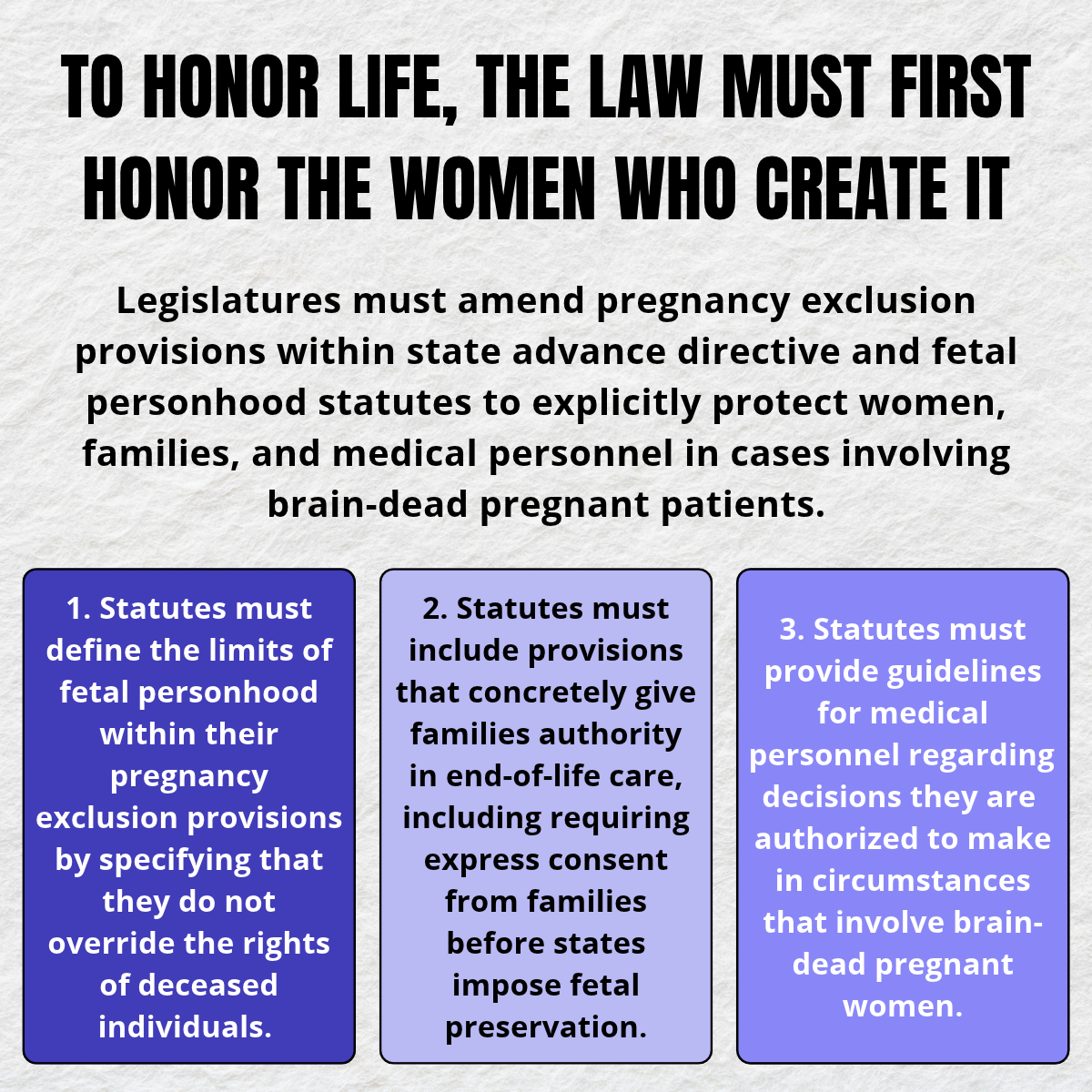
To Honor Life, The Law Must First Honor The Women Who Create It
Legislatures must amend pregnancy exclusion provisions within state advance directive and fetal personhood statutes to explicitly protect women, families, and medical personnel in cases involving brain-dead pregnant patients.
1. Statutes must define the limits of fetal personhood within their pregnancy exclusion provisions by specifying that they do not override the rights of deceased individuals.
2. Statutes must include provisions that concretely give families authority in end-of-life care, including requiring express consent from families before states impose fetal preservation.
3. Statutes must provide guidelines for medical personnel regarding decisions they are authorized to make in circumstances that involve brain-dead pregnant women.
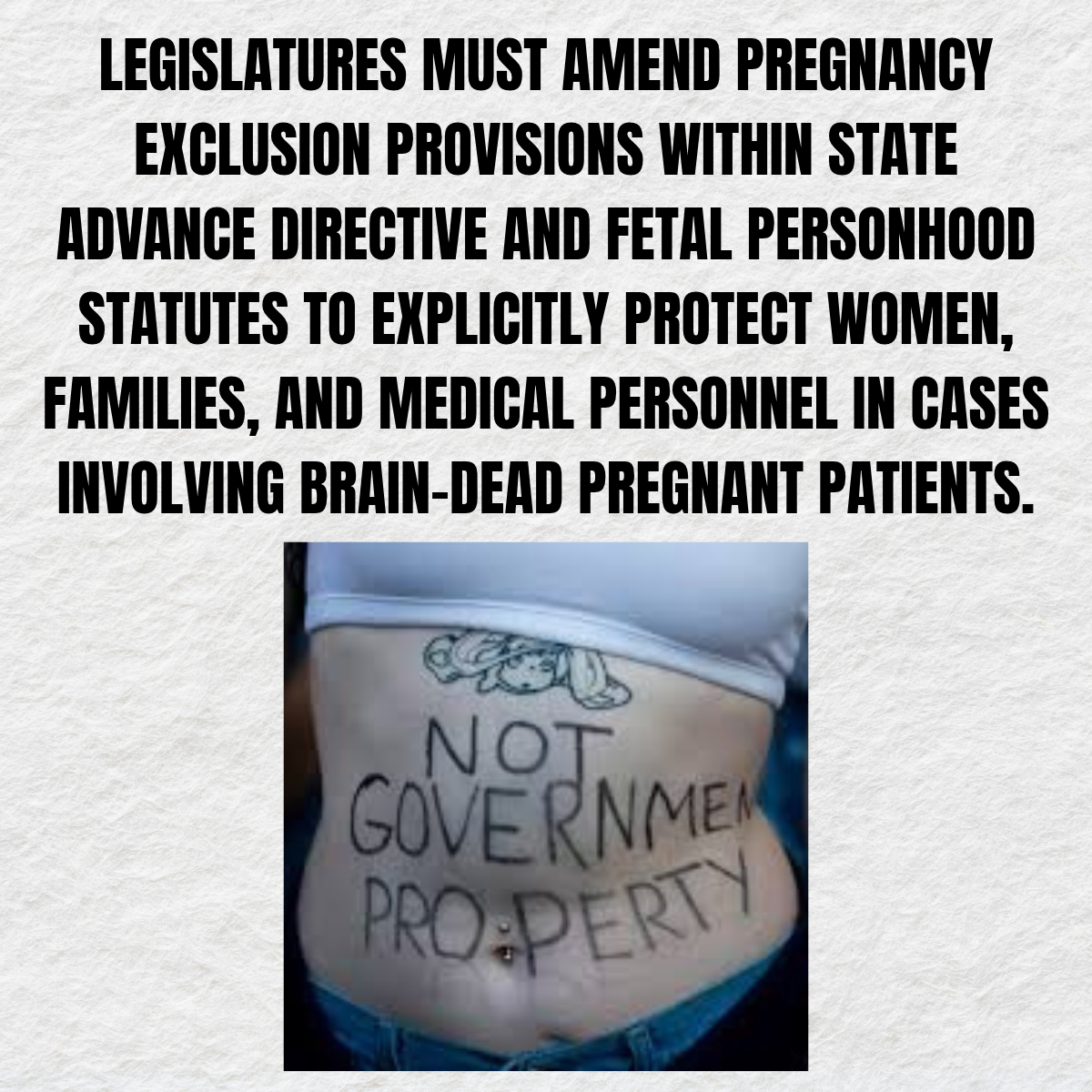
Legislatures must amend pregnancy exclusion provisions within state advance directive and fetal personhood statutes to explicitly protect women, families, and medical personnel in cases involving brain-dead pregnant patients.
Image of a woman’s torso with the words “not government property” written on it.
Sources
Slide 2: Jess Mador, Does Georgia's fetal 'personhood' law mean a pregnant woman must stay on life support?, NPR (June 7, 2025, at 05:00 ET), https://www.npr.org/sections/shots-health-news/2025/06/07/nx-s1-5425384/georgia-anti-abortion-fetal-personhood-law-pregnant-woman-life-support [https://perma.cc/6CZZ-4QY2].
Slide 3: Meyer v. Nebraska, 262 U.S. 390, 399-401(1923);Pierce v. Society of the Sisters of the Holy Names of Jesus and Mary, 268 U.S. 510, 534-36 (1925); Griswold v. Connecticut, 381 U.S. 479, 485-86 (1965); Eisenstadt v. Baird, 405 U.S. 438, 453 (1972); Roe v. Wade, 410 U.S. 113, 153-55 (1973); Planned Parenthood of Southeastern Pennsylvania v. Casey, 505 U.S. 833, 878-79 (1992); Dobbs v. Jackson Women’s Health Organization, 597 U.S. 215, 292 (2022).
Slide 4: Adam Edelman, An uptick in state personhood bills fuels growing fears over IVF restrictions, NBC News (Feb. 26, 2024, at 16:21 ET), https://www.nbcnews.com/politics/personhood-bills-ivf-restrictions-alabama-rcna140228 [https://perma.cc/C6C4-8W3K].
Slide 5: Laws By State, Pregnancy Just. (Oct. 20, 2026), https://www.pregnancyjusticeus.org/legal-landscape/ [https://perma.cc/5JA9-RTAP].
Slide 6: Unif. Health-Care Decisions Act (Unif. L. Comm’n 2023); Unif. Determination of Death Act § 1 (Unif. L. Comm'n 1980); Mayo Clinic Staff, Living wills and advance directives for medical decisions, Mayo Clinic (Mar. 25, 2025), https://www.mayoclinic.org/healthy-lifestyle/consumer-health/in-depth/living-wills/art-20046303 [https://perma.cc/4ZAH-HS5K].
Slide 7: Laws By State, Pregnancy Just., supra.
Slide 9: Jeff Amy & Geoff Mulvihill, Brain-dead woman must carry fetus to birth because of Georgia’s abortion ban, hospital tells family, PBS News (May 15, 2025, at 14:47 ET), https://www.pbs.org/newshour/nation/brain-dead-woman-must-carry-fetus-to-birth-because-of-georgias-abortion-ban-hospital-tells-family [https://perma.cc/9665-ZX8N]; Alyssa Burgart & Jennifer Conti, Georgia Shouldn’t Be Allowed to Force a Brain-Dead Woman’s Body to Incubate a Fetus, U.S. News (May 29, 2025, at 17:30 ET), https://www.usnews.com/opinion/articles/2025-05-29/medical-georgia-pregnant-abortion-brain-dead [https://perma.cc/6XJY-7C4Q].