
The Children Can’t Read! The Literacy Crisis: What You Need to Know and Why it Matters
The Children Can’t Read! The Literacy Crisis: What You Need to Know and Why it Matters by Elaysha Brown
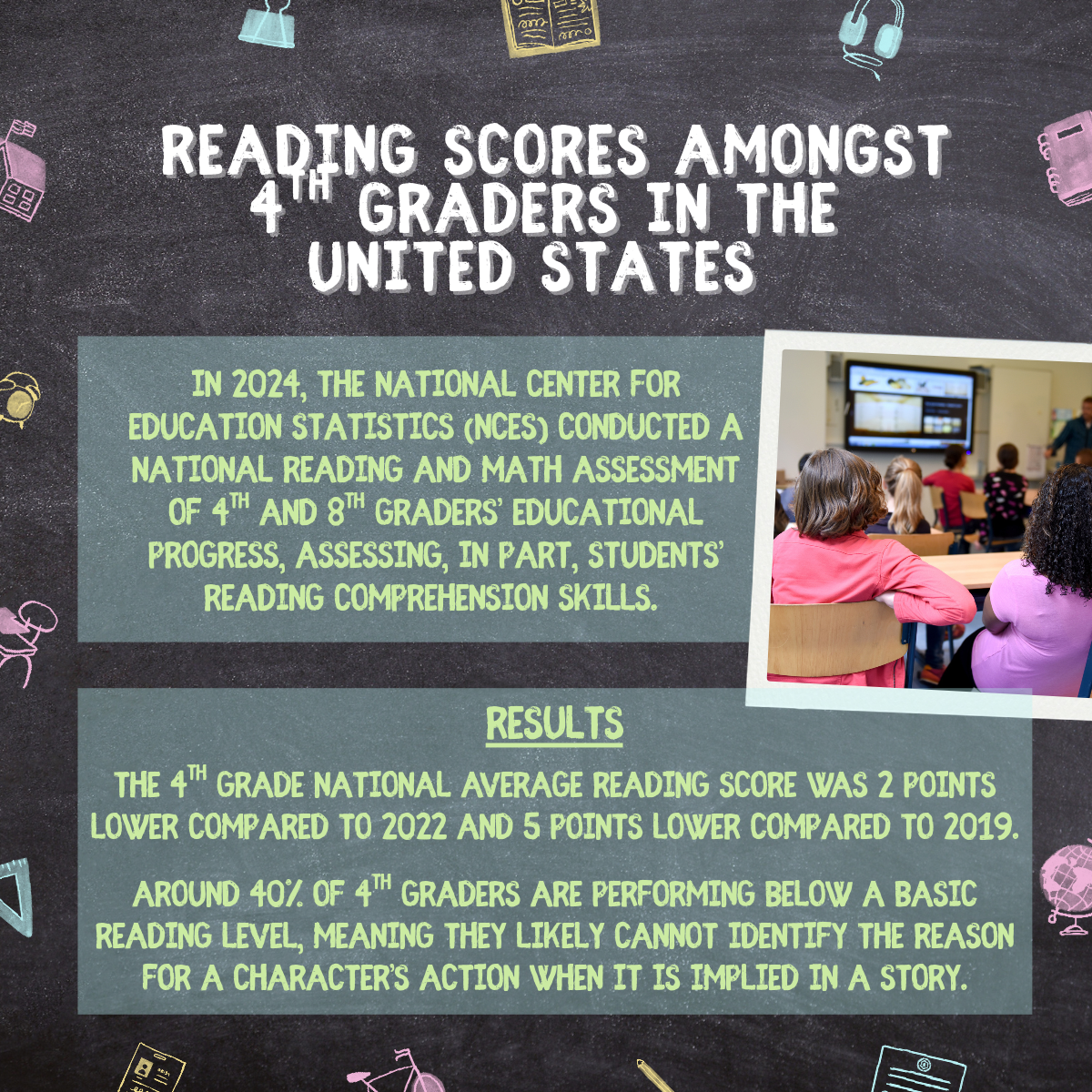
Reading Scores Amongst 4th Graders in the United States
In 2024, the National Center for Education Statistics (NCES) conducted a national reading and math Assessment of 4th and 8th graders’ educational progress, assessing, in part, students’ reading comprehension skills.
Results: The 4th grade national average reading score was 2 points lower compared to 2022 and 5 points lower compared to 2019. Around 40% of 4th graders are performing below a basic reading level, meaning they likely cannot identify the reason for a character’s action when it is implied in a story.
Image of children in a classroom.
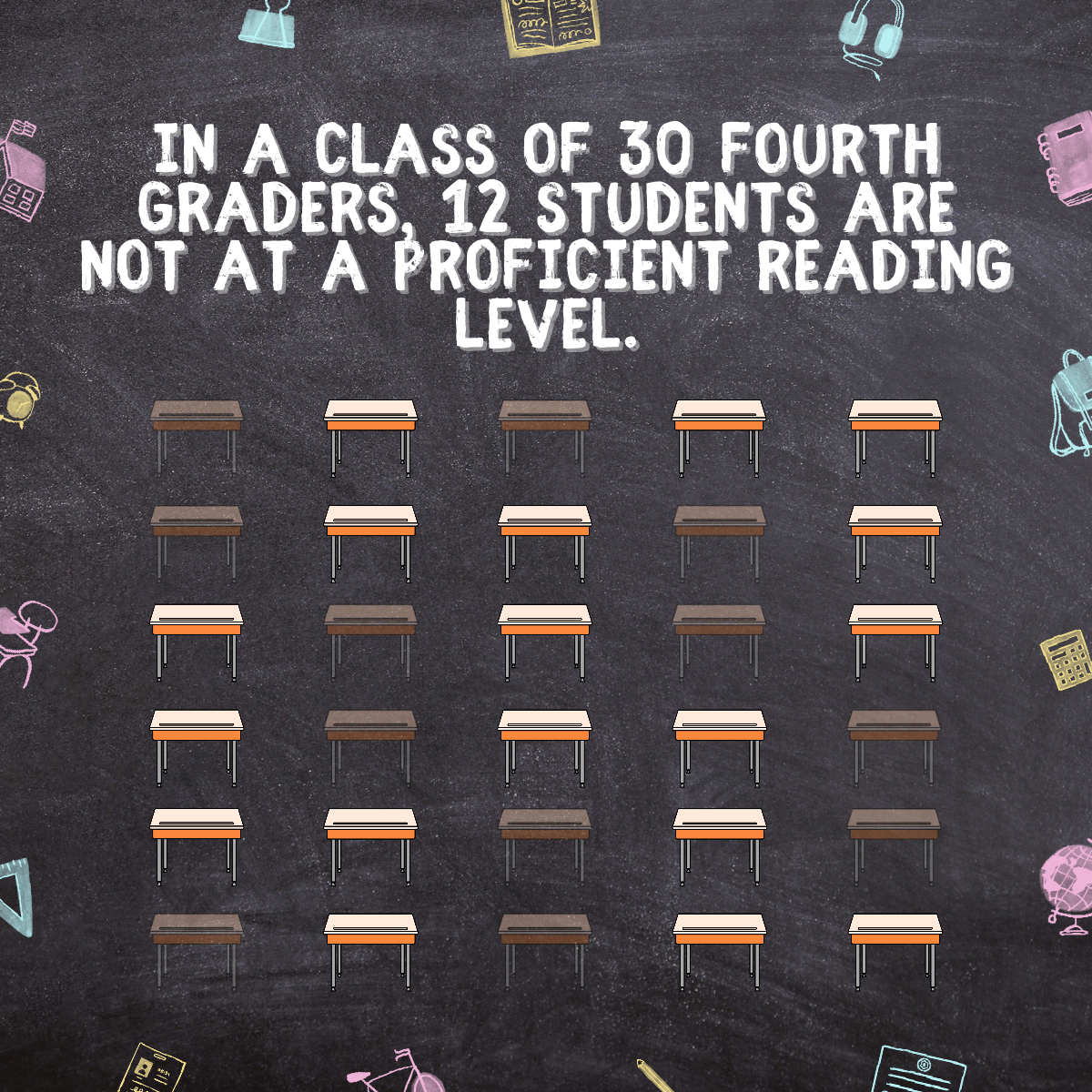
In a Class of 30 Fourth Graders, 12 Students Are Not At a Proficient Reading Level.
Image of 30 classroom desks. 12 desks are highlighted.
Federal Education Laws in the U.S.
The Elementary and Secondary Education Act (1965) expanded the federal government’s role in K-12 education, directing resources to support the education of the nation’s poorest children.
No Child Left Behind (2001) introduced a new era of federal accountability, requiring states to report test scores to the Department of Education and meet strict targets for every student subgroup. Critics said it focused too heavily on testing and pressured schools to remove low-performing students to protect their funding.
The Every Student Succeeds Act (2015) shifted the focus toward helping all students succeed in college and careers and gave states far more control, such as allowing states to set their own academic standards.
What Is Literacy?
“Acquiring literacy is not a one-off act. Beyond its conventional concept as a set of reading, writing and counting skills, literacy is now understood as a means of identification, understanding, interpretation, creation, and communication . . . Literacy is a continuum of learning and proficiency in reading, writing and using numbers throughout life and is part of a larger set of skills . . . .”
~ United Nations Educational, Scientific, and Cultural Organization
The Three-Cueing System (1967)
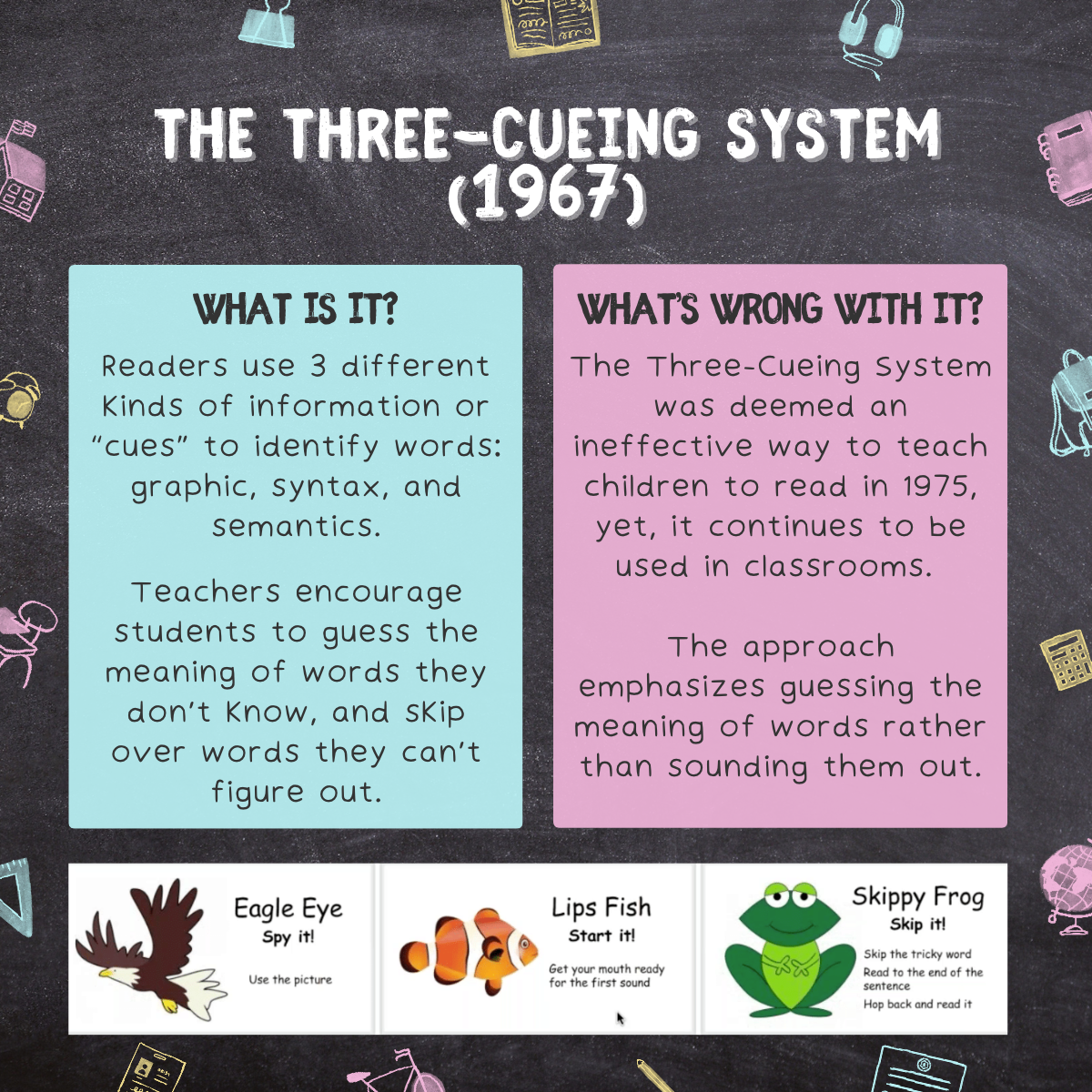
What Is It? Readers use 3 different kinds of information or “cues” to identify words: graphic, syntax, and semantics. Teachers encourage students to guess the meaning of words they don’t know, and skip over words they can’t figure out.
What’s Wrong With It? The Three-Cueing System was deemed an ineffective way to teach children to read in 1975, yet, it continues to be used in classrooms. The approach emphasizes guessing the meaning of words rather than sounding them out.
Images are examples of the steps teachers encourage students to take to guess the meaning of words they don’t know. The first image is of an eagle and reads “Eagle Eye. Spy it! Use the picture.” The second image is of a fish and reads “Lips Fish. Start it! Get your mouth ready for the first sound.” The third image is of a frog and reads “Skippy Frog. Skip it! Skip the tricking word. Read to the end of the sentence. Hop back and read it.”
A Return to the Science of Reading
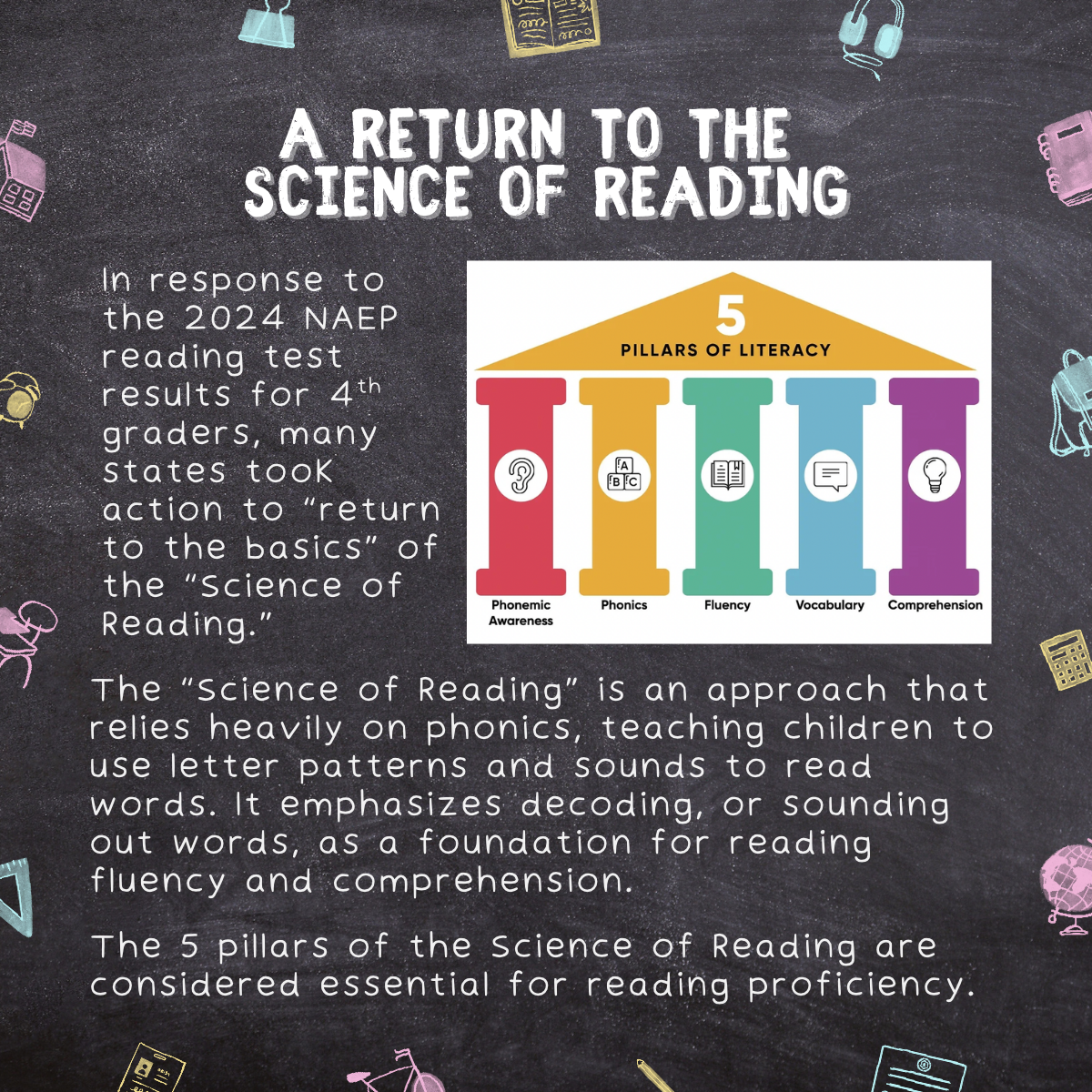
In response to the 2024 NAEP reading test results for 4th graders, many states took action to “return to the basics” of the “Science of Reading.” The “Science of Reading” is an approach that relies heavily on phonics, teaching children to use letter patterns and sounds to read words. It emphasizes decoding, or sounding out words, as a foundation for reading fluency and comprehension. The 5 pillars of the Science of Reading are considered essential for reading proficiency.
Image of the five pillars of literacy: phonemic awareness, phonics, fluency, vocabulary, and comprehension.
States’ Varied Approaches
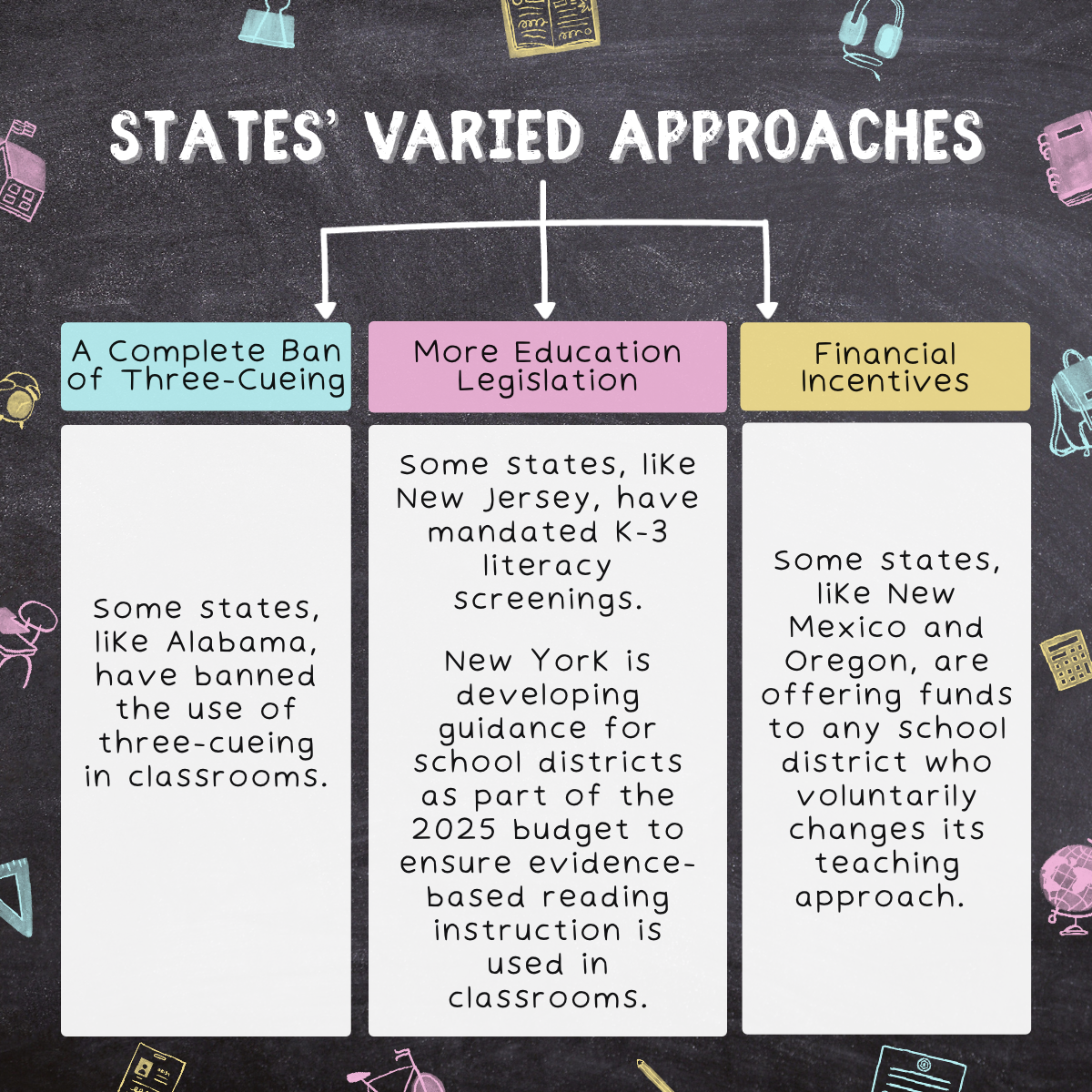
A Complete Ban of Three-Cueing: Some states, like Alabama, have banned the use of three-cueing in classrooms.
More Education Legislation: Some states, like New Jersey, have mandated K-3 literacy screenings. New York is developing guidance for school districts as part of the 2025 budget to ensure evidence-based reading instruction is used in classrooms.
Financial Incentives: Some states, like New Mexico and Oregon, are offering funds to any school district who voluntarily changes its teaching approach.
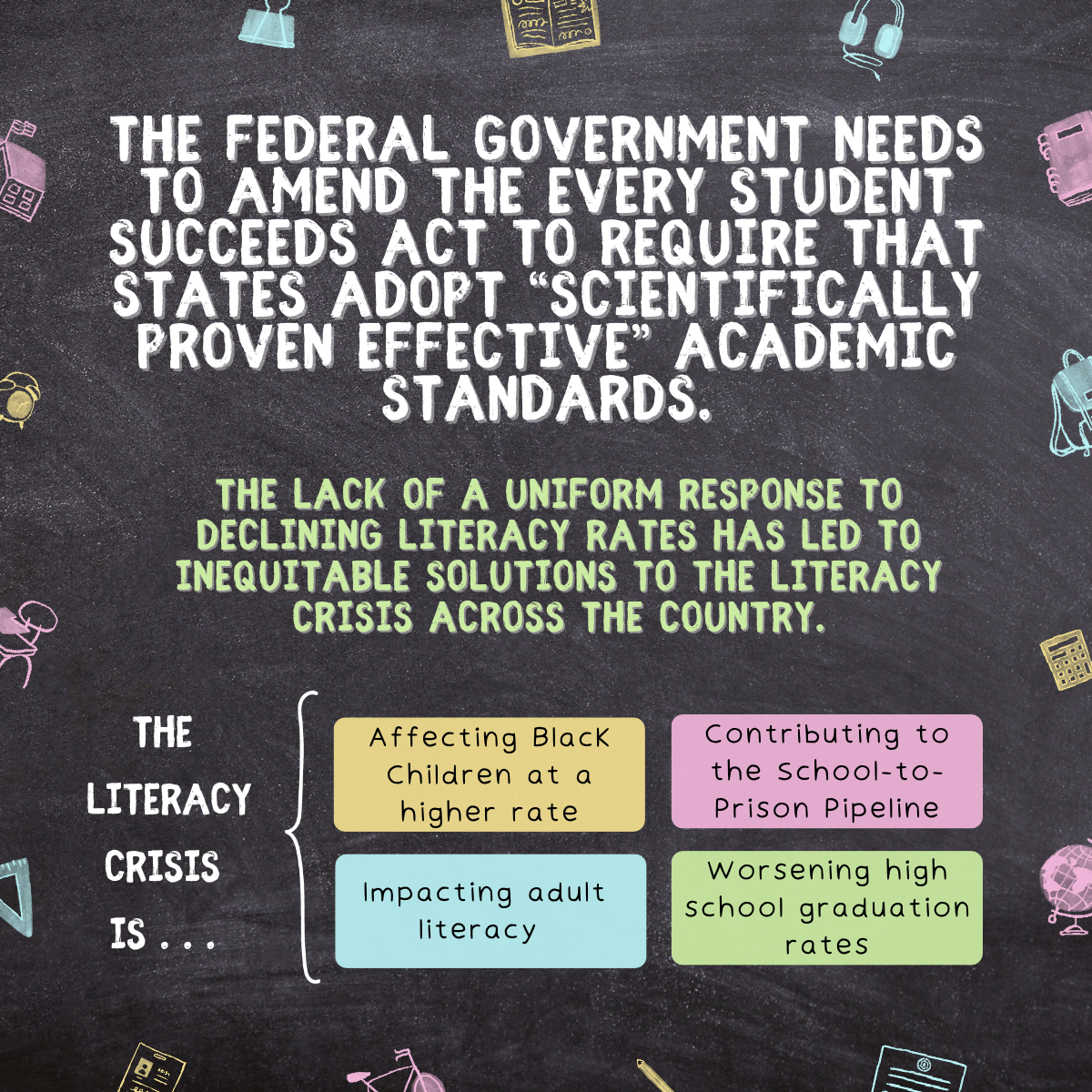
The Federal Government Needs To Amend The Every Student Succeeds Act To Require That States Adopt “Scientifically Proven Effective” Academic Standards.
The lack of a uniform response to declining literacy rates has led to inequitable solutions to the literacy crisis across the country. The literacy crisis is affecting Black children at a higher rate, contributing to the School-to-Prison Pipeline, impacting adult literacy, and worsening high school graduation rates.
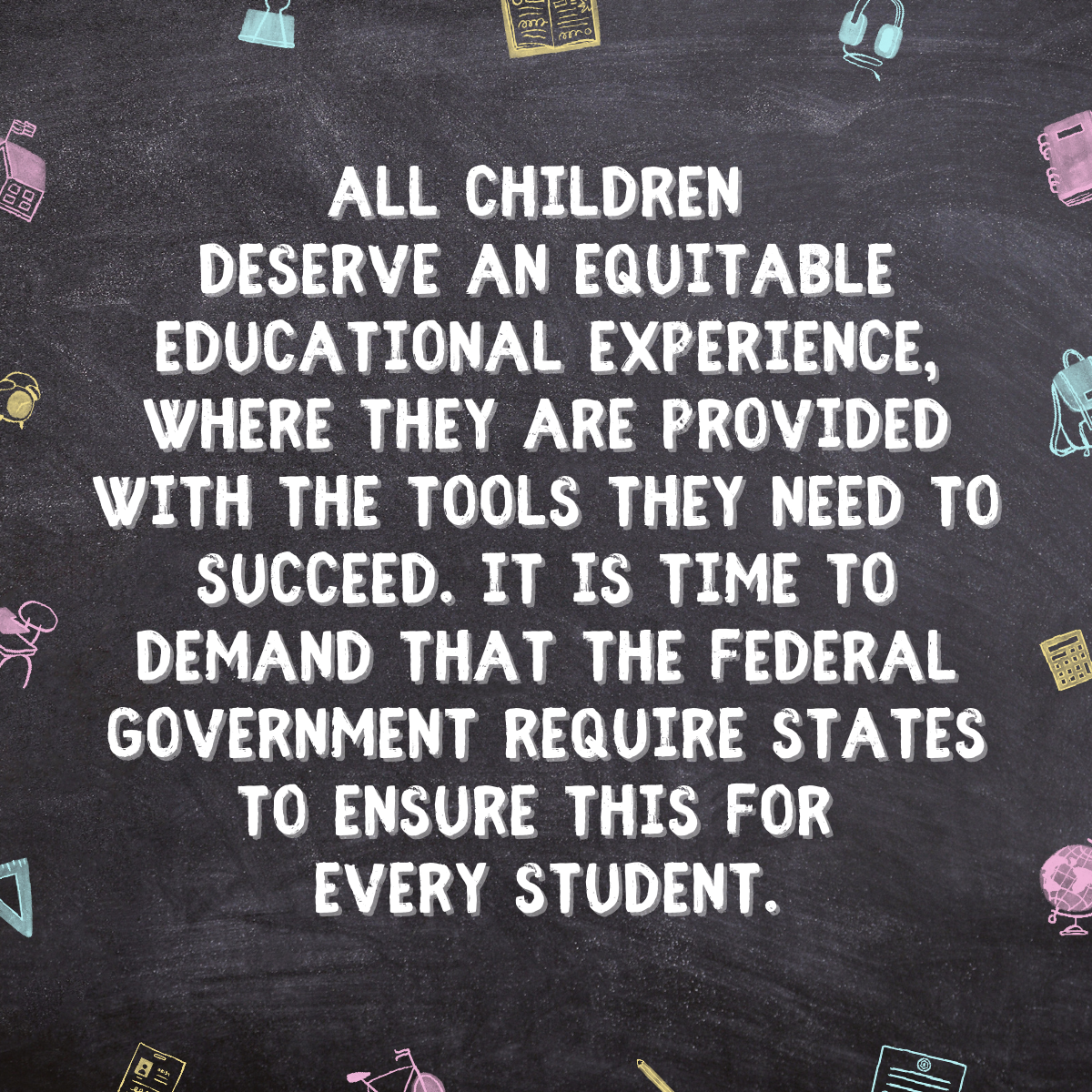
All children deserve an equitable educational experience, where they are provided with the tools they need to succeed. It is time to demand that the federal government require states to ensure this for every student.
Sources
Slide 2: The Nation's Report Card Shows Declines in Reading, Some Progress in 4th Grade Math, Nat’l Assessment Governing Bd. (Jan. 9, 2025), https://www.nagb.gov/news-and-events/news-releases/2025/nations-report-card-decline-in-reading-progress-in-math.html [https://perma.cc/PDE3-F5N5]; NAEP Report Card: Reading, Nation’s Rep. Card, https://www.nationsreportcard.gov/reports/reading/2024/g4_8/ [https://perma.cc/PDE3-F5N5] (last visited Nov. 20, 2026).
Slide 4: Alyson Klein, ESEA’s 50-Year Legacy a Blend of Idealism, Policy Tensions, Educ. Wk. (Mar. 31, 2015), https://www.edweek.org/policy-politics/eseas-50-year-legacy-a-blend-of-idealism-policy-tensions/2015/03 [https://perma.cc/L9NJ-WVEV]; Every Student Succeeds Act (ESSA), U.S. Dep’t of Educ. (Nov. 9, 2026), https://www.ed.gov/laws-and-policy/laws-preschool-grade-12-education/every-student-succeeds-act-essa [https://perma.cc/E63Q-AG46].
Slide 5: What you need to know about literacy, UNESCO (Nov. 2, 2026), https://www.unesco.org/en/literacy/need-know [https://perma.cc/F2WF-6UM7]
Slide 6: Whole Language vs. Phonics: The History of the Reading Wars, Lexia (Aug. 13, 2025), https://www.lexialearning.com/blog/the-science-of-reading-vs-balanced-literacy-the-history-of-the-reading-wars [https://perma.cc/T9PG-YHNU].
Slide 7: A Full Breakdown of the Science of Reading Components, Lexia (Mar. 17, 2025), https://www.lexialearning.com/blog/a-full-breakdown-of-the-science-of-reading-components [https://perma.cc/UAH6-LLFD]; Kelly Gary, The Reading Brain and Five Pillars of Literacy, Penn Woods Classical Acad. (Oct. 3, 2023), https://pennwoodsclassical.org/the-reading-brain-and-five-pillars-of-literacy/ [https://perma.cc/4KFG-NYSE].
Slide 8: Christopher Peak, New reading laws sweep the nation following Sold a Story, APM Reps. (Oct. 16, 2025), https://www.apmreports.org/story/2025/10/16/legislators-reading-laws-sold-a-story [https://perma.cc/8AFY-KPM9].
Slide 9: Id.; Triston Ezidore, I faked reading in third grade. Too many Black kids still have to, EdSource (Aug. 4, 2025), https://edsource.org/2025/literacy-crisis-black-children/737967 [https://perma.cc/HT79-M4NU]; Why Access to Education is Key to Systemic Equality, Am. C.L. Union (Sep. 6, 2023), https://www.aclu.org/news/racial-justice/why-access-to-education-is-key-to-systemic-equality [https://perma.cc/CBR4-GWLH]; Diane Benson Harrington, Moving ahead while left behind — The plight of older students without reading proficiency, SmartBrief (Feb. 12, 2024), https://www.smartbrief.com/original/older-students-illiterate [https://perma.cc/8UN2-A22R]; Donald J. Hernandez, Double Jeopardy: How Third-Grade Reading Skills and Poverty Influence High School Graduation 4 (2011), https://files.eric.ed.gov/fulltext/ED518818.pdf [https://perma.cc/9BXJ-U5M9].